
Evolution of Troponin Standards: From cTnI Instability to Engineered Proteins
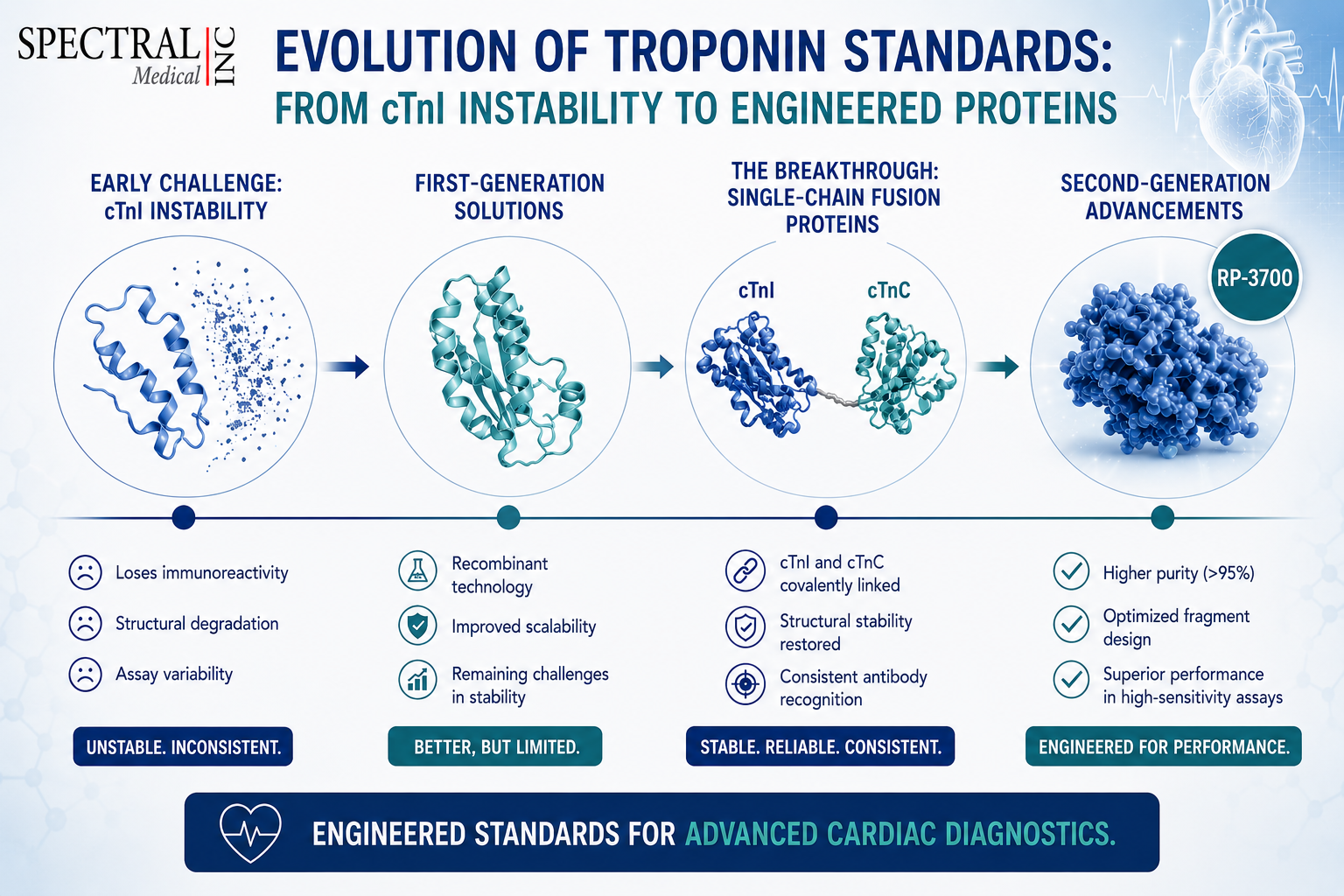
Cardiac Troponin testing has become the cornerstone of modern cardiac diagnostics. Today, Cardiac Troponin assays are widely recognized as the gold standard for detecting myocardial injury and play a critical role in the diagnosis and management of acute myocardial infarction (MI).
Over the past two decades, advances in assay sensitivity have dramatically improved clinicians’ ability to detect cardiac injury at increasingly lower concentrations. However, the performance of a Cardiac Troponin assay depends on more than antibodies and instrumentation. Reliable calibration and quality control materials are equally important for ensuring accuracy, reproducibility, and standardization.
The evolution of Cardiac Troponin reference materials has therefore been a key contributor to the advancement of modern immunoassays. From unstable native proteins to engineered recombinant fusion proteins, significant innovation has occurred behind the scenes to support the cardiac diagnostic tests used every day in clinical laboratories worldwide.
The Early Challenge: Instability of Cardiac Troponin I
Cardiac Troponin I (cTnI) is a highly specific biomarker released into circulation following damage to cardiac muscle cells. While its clinical utility is well established, cTnI presents several challenges when used as a reference or calibration material.
Free cTnI is inherently unstable in solution and can undergo structural changes over time. These changes may affect antibody recognition and contribute to variability in assay performance.
Potential consequences include:
- Loss of immunoreactivity
- Structural degradation
- Reduced epitope accessibility
- Calibration variability
- Reduced assay reproducibility
As diagnostic assays became increasingly sensitive, maintaining a stable and well-characterized Troponin reference material became a growing challenge. Small structural changes in the protein could influence antibody binding and ultimately affect analytical performance.
For assay developers and manufacturers, improving the stability of Troponin reference materials became an important objective.
First-Generation Recombinant Troponin Materials
The introduction of recombinant protein technology represented an important advancement in Cardiac Biomarker manufacturing.
Compared with native protein preparations, recombinant expression systems enabled improved control over production, purification, and characterization. These technologies provided greater consistency, enhanced scalability, and more reliable supply.
Benefits of recombinant production included:
- Improved batch-to-batch consistency
- Defined molecular composition
- Enhanced manufacturing scalability
- Greater supply reliability
- Better analytical characterization
While recombinant production addressed many manufacturing challenges, it did not completely solve the structural limitations associated with free cTnI. Stability and epitope presentation remained important considerations for calibration and quality control applications.
The industry still needed a reference material that more closely reflected the biological relationship between Troponin I and its natural binding partner, Troponin C.
The Breakthrough: Single-Chain Troponin I-C Fusion Proteins
A major breakthrough occurred with the development of recombinant Single-Chain Troponin I-C Fusion Proteins.
In pioneering work conducted at Spectral Medical, Liu et al. demonstrated that covalently linking Cardiac Troponin I (cTnI) and Cardiac Troponin C (cTnC) into a single recombinant molecule created superior calibration and control materials for Cardiac Troponin immunoassays.¹
Rather than relying on separate proteins or non-covalent complexes, the single-chain architecture permanently joins cTnI and cTnC within a single polypeptide chain. This innovative design provides several important advantages:
- Fixed stoichiometry between cTnI and cTnC
- Improved structural stability
- Consistent epitope presentation
- Preserved immunoreactivity
- Reduced variability compared with mixed preparations
Because both analytes remain present within the same molecule, antibodies directed against either Troponin I or Troponin C can recognize the material while maintaining a defined structural context.
This dual-analyte architecture is not an added feature—it is an inherent consequence of the molecular design.
The work published by Liu and colleagues helped establish the foundation for modern Single-Chain Troponin I-C reference materials and demonstrated how protein engineering could directly improve assay calibration and quality control performance.
Reference
Liu S, Bowers GN Jr, Toftager-Larsen K, et al. Recombinant single-chain cardiac Troponin I-C polypeptides: superior calibration and control materials for Cardiac Troponin I immunoassays. Clin Lab. 2001;47(1–2):19–27. PMID: 11214219.