
Designing Reliable Cardiac Assays: The Role of Recombinant Troponin and NT-proBNP Proteins in IVD Development
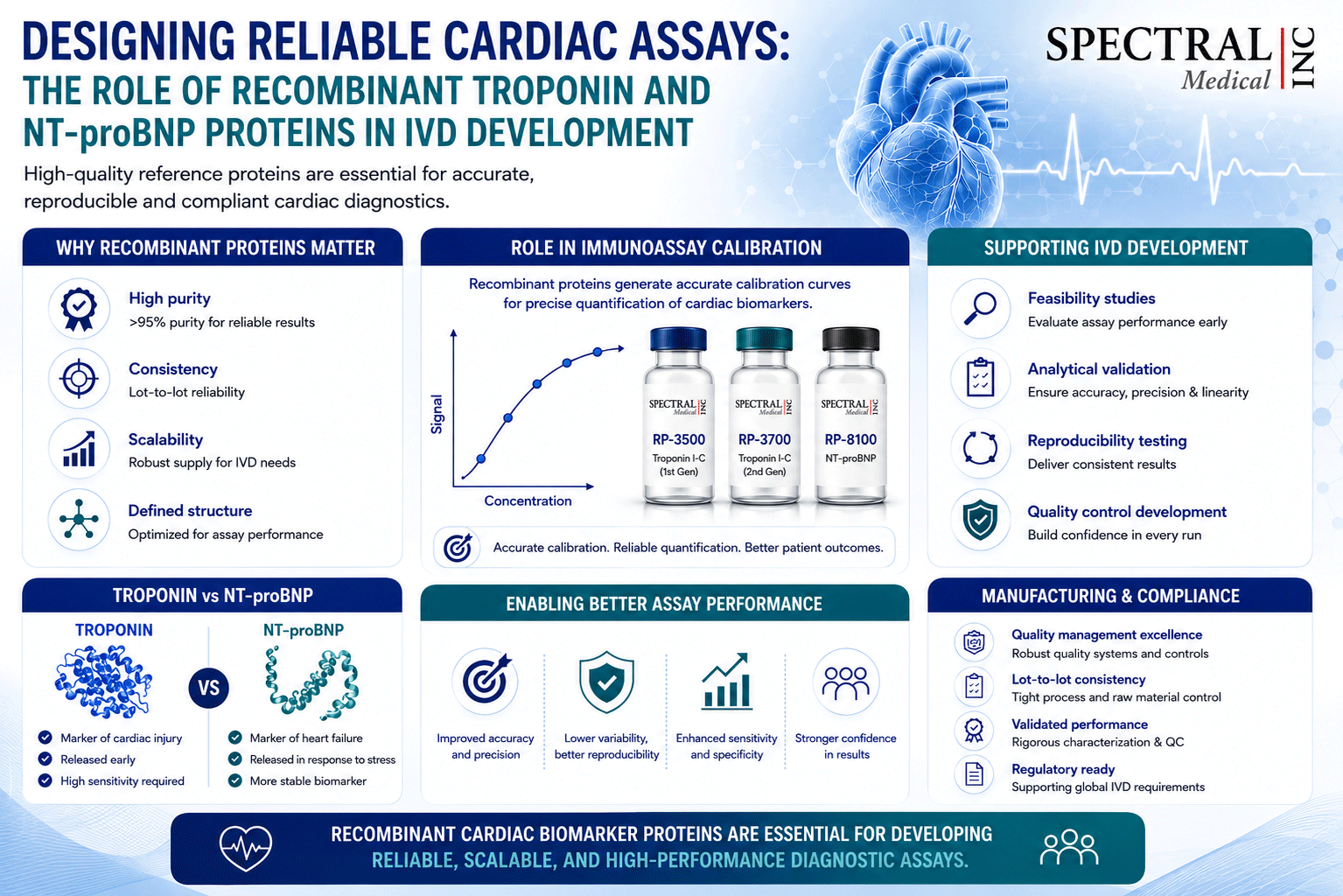
The development of reliable cardiac diagnostic assays depends on more than antibody selection and instrument performance. Behind every successful assay is a foundation of well-characterized reference materials that support calibration, validation, quality control, and long-term reproducibility.
As cardiac diagnostics continue to evolve toward greater analytical sensitivity and precision, the quality of the biomarker proteins used during assay development becomes increasingly important. Recombinant cardiac biomarker proteins provide the consistency, scalability, and structural definition required to support modern in vitro diagnostic (IVD) assay development.
Among the most important cardiac biomarkers are Troponin and NT-proBNP, which play complementary roles in assessing cardiovascular health. Together, these proteins help support the diagnosis and management of myocardial injury and heart failure, two of the most common and clinically significant cardiovascular conditions worldwide.
Why Recombinant Proteins Matter in IVD Development
Reference materials are used throughout the diagnostic development lifecycle. Whether generating calibration curves, validating assay performance, or developing quality control materials, assay developers rely on proteins that are consistent, reproducible, and well characterized.
Recombinant protein technology offers several advantages over less-defined biological materials:
- High purity
- Consistent molecular composition
- Scalable manufacturing
- Reliable long-term supply
- Defined structural properties
- Improved lot-to-lot consistency
These characteristics make recombinant proteins particularly valuable for diagnostic applications where reproducibility and standardization are critical.
By providing a stable and well-characterized starting point, recombinant proteins help reduce variability and improve confidence in assay performance.
The Role of Reference Materials in Cardiac Assays
Reference materials serve as the foundation of assay calibration and analytical validation.
Throughout development, recombinant cardiac biomarker proteins are commonly used to:
- Generate calibration curves
- Establish assay performance characteristics
- Support analytical validation
- Develop quality control materials
- Assess assay reproducibility
- Compare assay performance across platforms
The quality of these materials directly influences the quality of the resulting assay.
As detection limits become lower and performance expectations continue to rise, reliable reference materials become increasingly important for achieving accurate and reproducible results.
Recombinant Troponin Proteins in Assay Development
Cardiac Troponin remains the gold-standard biomarker for detecting myocardial injury and acute myocardial infarction.
Because Troponin assays must accurately measure very low concentrations of biomarker, developers require calibration materials that provide consistent antibody recognition and reproducible analytical performance.
Single-Chain Troponin I-C proteins such as RP-3500 and RP-3700 were developed specifically to address these requirements.
Originally pioneered at Spectral Medical, the Single-Chain Troponin I-C approach covalently links Cardiac Troponin I (cTnI) and Cardiac Troponin C (cTnC) into a single recombinant molecule, providing a structurally defined reference material for assay development and calibration.¹
This architecture offers several advantages:
- Improved structural stability
- Fixed stoichiometry
- Consistent epitope presentation
- Preserved immunoreactivity
- Reproducible calibration performance
These characteristics make Single-Chain Troponin I-C proteins valuable tools for assay development, analytical validation, and quality control applications.
Recombinant NT-proBNP Proteins in Assay Development
While Troponin is used primarily as a marker of myocardial injury, NT-proBNP serves as a key biomarker for heart failure and cardiac stress.
NT-proBNP testing is widely used for diagnosis, prognosis, and patient management in heart failure and is increasingly incorporated into comprehensive cardiac testing panels.
Recombinant NT-proBNP proteins provide developers with well-characterized materials for:
- Calibration curve generation
- Method development
- Analytical validation
- Quality control preparation
- Assay performance studies
Products such as RP-8100 provide a consistent recombinant NT-proBNP source suitable for supporting assay development and validation activities.
Supporting the Full Assay Development Lifecycle
Cardiac biomarker proteins are used throughout every stage of IVD development.
Feasibility Studies
Evaluation of assay concepts, antibodies, and analytical approaches.
Assay Optimization
Development of assay conditions, calibration strategies, and performance targets.
Analytical Validation
Assessment of sensitivity, precision, linearity, accuracy, and reproducibility.
Quality Control Development
Creation of control materials used to monitor assay performance over time.
Manufacturing Scale-Up
Support for the transition from research and development to commercial production.
Because recombinant proteins can be manufactured consistently and supplied at scale, they provide continuity throughout the product lifecycle.
Troponin and NT-proBNP: Complementary Biomarkers
Although both biomarkers are widely used in cardiac diagnostics, they provide different clinical insights.
Troponin
Troponin is primarily used to identify myocardial injury.
Key characteristics include:
- Marker of cardiac muscle damage
- High clinical specificity
- Essential for acute myocardial infarction diagnosis
- Requires highly sensitive detection
NT-proBNP
NT-proBNP is primarily used to assess heart failure and cardiac stress.
Key characteristics include:
- Marker of heart failure
- Supports diagnosis and prognosis
- Useful for patient monitoring
- Common component of cardiac testing panels
Together, Troponin and NT-proBNP provide complementary information that supports a more comprehensive assessment of cardiovascular disease.
Conclusion
Reliable cardiac assays begin with reliable reference materials.
Recombinant cardiac biomarker proteins provide the purity, consistency, scalability, and structural definition required to support modern IVD assay development. Whether used for calibration, analytical validation, quality control, or manufacturing scale-up, these materials help establish the foundation for accurate and reproducible diagnostic testing.
As cardiac diagnostics continue to advance, recombinant proteins such as Single-Chain Troponin I-C and NT-proBNP will remain essential tools for developing the next generation of high-performance cardiac assays.
Reference
Liu S, Bowers GN Jr, Toftager-Larsen K, et al. Recombinant single-chain cardiac Troponin I-C polypeptides: superior calibration and control materials for cardiac Troponin I immunoassays. Clin Lab. 2001;47(1–2):19–27. PMID: 11214219.