
Why Single-Chain Troponin I–C Fusion Proteins Are Transforming Cardiac Immunoassay Calibration
Accurate Cardiac Troponin testing depends on more than sensitive antibodies and advanced instrumentation. The quality of the calibration and reference materials used during assay development plays a critical role in determining assay accuracy, reproducibility, and long-term performance.
As Cardiac Troponin assays have evolved toward increasingly sensitive detection limits, assay developers have faced growing demands for stable, well-characterized reference materials that can support consistent calibration and quality control. Traditional Troponin preparations can present challenges related to structural stability, epitope presentation, and assay reproducibility.
Single-Chain Troponin I-C fusion proteins were developed to address these challenges by providing a structurally defined recombinant reference material specifically designed for Cardiac Troponin immunoassays.
What Are Single-Chain Troponin I-C Fusion Proteins?
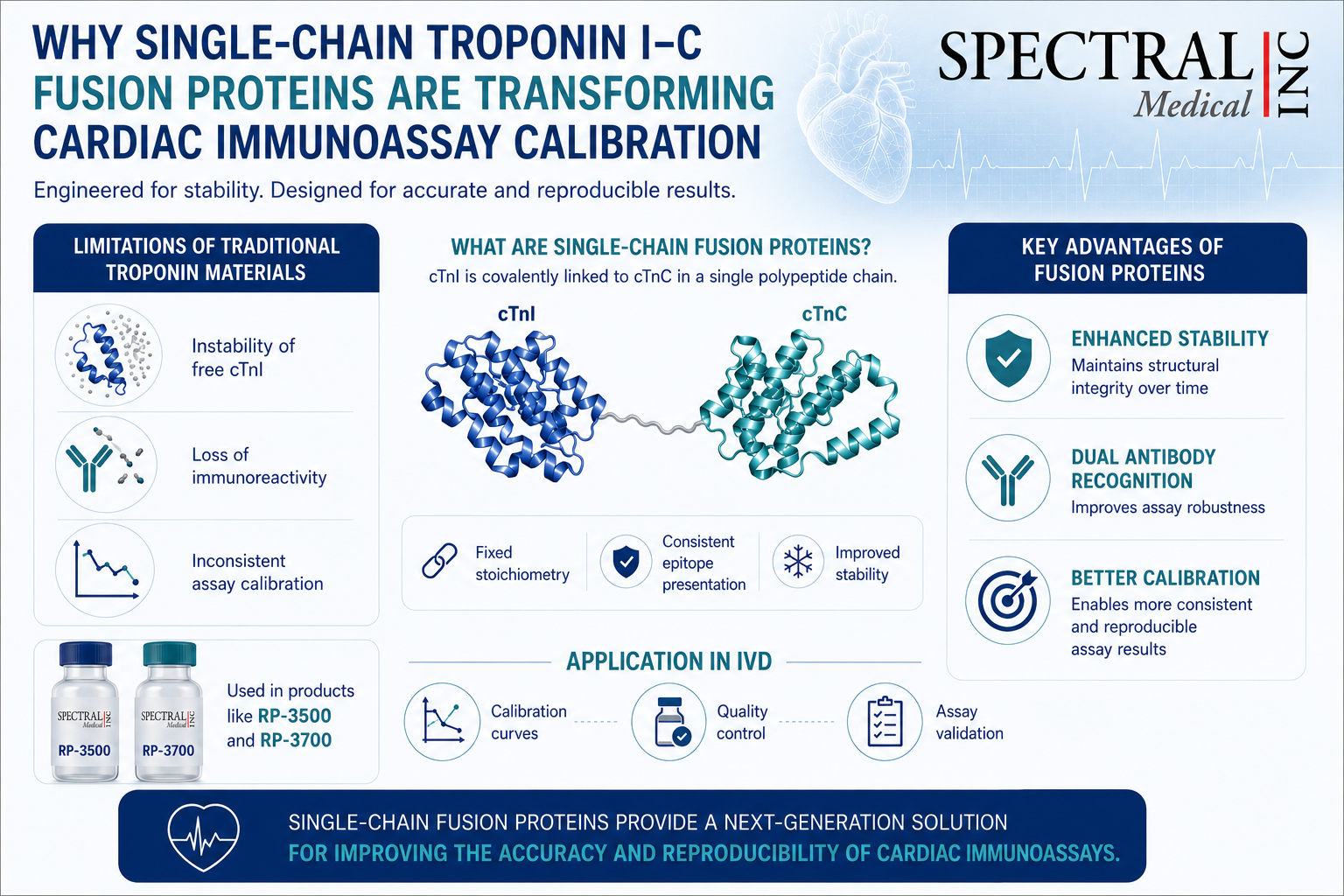
A significant advancement in Troponin reference materials came with the development of Single-Chain Troponin I-C fusion proteins. Originally developed by researchers at Spectral Medical and described by Liu et al. in 2001, this approach involved covalently linking Cardiac Troponin I (cTnI) and Cardiac Troponin C (cTnC) into a single recombinant molecule.¹
Unlike conventional preparations that contain individual proteins or rely on non-covalent interactions between Troponin components, the single-chain format permanently joins both analytes into one defined molecular structure.
This architecture provides several important characteristics:
- Fixed stoichiometry between cTnI and cTnC
- Consistent epitope presentation
- Improved structural stability
- Preserved immunoreactivity
- Reproducible molecular composition
Because both proteins are present within the same molecule, antibodies directed against either Troponin I or Troponin C can recognize the material while maintaining a consistent structural context.
The result is a more stable and functionally representative reference material that is well suited for assay calibration, quality control, and method development applications.
Why Traditional Troponin Materials Can Be Challenging
Cardiac Troponin I is one of the most clinically important biomarkers of myocardial injury. However, free cTnI presents several challenges when used as a calibration material.
In solution, free cTnI can undergo structural changes over time that may affect antibody recognition and assay performance. Depending on storage conditions and assay design, these changes can contribute to variability in analytical measurements.
Common challenges associated with traditional Troponin materials include:
- Instability of free cTnI
- Loss of immunoreactivity over time
- Variable epitope presentation
- Reduced reproducibility
- Calibration variability
As Cardiac Troponin assays continue to become more sensitive, minimizing these sources of variability becomes increasingly important.
Key Advantages of Single-Chain Troponin I-C Fusion Proteins
Enhanced Stability
By permanently linking cTnI and cTnC into a single recombinant molecule, Single-Chain Troponin I-C fusion proteins maintain a defined structural relationship between both analytes.
This helps preserve molecular integrity and reduces variability associated with dissociation or structural changes that may occur in conventional preparations.
Fixed Stoichiometry
Both Troponin I and Troponin C are present in a fixed ratio within every molecule.
This eliminates variability associated with mixed protein preparations and provides a more consistent reference material for assay development and calibration.
Consistent Epitope Presentation
The single-chain architecture helps maintain a reproducible structural context for antibody binding.
As a result, assay developers can work with a material that delivers consistent epitope presentation from lot to lot.
Dual Antibody Recognition
Because both Troponin I and Troponin C epitopes are present within the same recombinant molecule, antibodies directed against either analyte can recognize the material.
This dual-analyte capability is not an added feature—it is a direct consequence of the molecular design.
Improved Calibration Performance
Stable structure, fixed stoichiometry, and preserved immunoreactivity contribute to more consistent calibration performance.
For diagnostic manufacturers, this can support improved assay reproducibility and more reliable analytical results.
Applications in IVD Development
Single-Chain Troponin I-C fusion proteins are used throughout the diagnostic assay development process.
Common applications include:
- Calibration curve generation
- Quality control materials
- Assay validation
- Method development
- Analytical performance studies
- Cross-platform assay comparisons
At Spectral Medical, RP-3500 and RP-3700 build upon the original Single-Chain Troponin I-C technology and provide recombinant reference materials for diagnostic manufacturers, assay developers, and research laboratories.
RP-3500 is an established Single-Chain Troponin I-C reference material widely used in assay development and calibration applications. RP-3700 represents a second-generation format featuring higher purity and an optimized construct designed for applications requiring enhanced analytical performance.
Why Reference Materials Matter
The quality of an immunoassay is directly influenced by the quality of the materials used to develop and calibrate it.
Reference materials serve as the foundation for:
- Assay accuracy
- Calibration consistency
- Reproducibility
- Method validation
- Long-term assay performance
As Cardiac Troponin assays continue to advance, the need for stable, well-characterized recombinant reference proteins becomes increasingly important.
Selecting an appropriate reference material can help reduce variability, improve assay robustness, and support reliable diagnostic performance.
Conclusion
Single-Chain Troponin I-C fusion proteins represent a significant advancement in Cardiac Troponin assay calibration and standardization.
By covalently linking Troponin I and Troponin C into a single recombinant molecule, these engineered proteins provide improved stability, fixed stoichiometry, consistent epitope presentation, and enhanced reproducibility compared with conventional Troponin preparations.
Building on technology originally developed at Spectral Medical, Single-Chain Troponin I-C reference materials continue to provide a reliable foundation for assay development, calibration, and quality control across the IVD industry. More than two decades after the original publication, the principles established by this work remain highly relevant to modern Cardiac Troponin assay development.
Reference
Liu S, Bowers GN Jr, Toftager-Larsen K, et al. Recombinant single-chain cardiac Troponin I-C polypeptides: superior calibration and control materials for cardiac Troponin I immunoassays. Clin Lab. 2001;47(1–2):19–27. PMID: 11214219.